
Home ≫ Human Trafficking and Sexual Slavery
Human Trafficking and Sexual Slavery
Slavery’s New Face
Sex Trafficking of Women and Girls
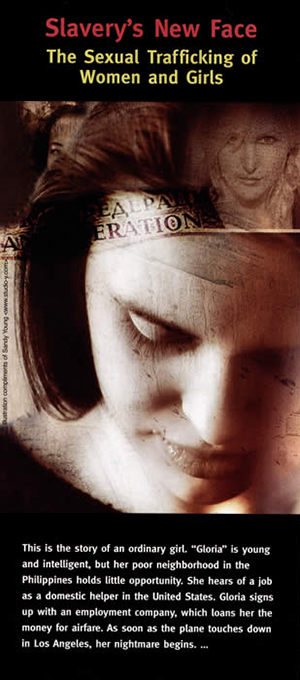 Slavery is a harsh reality for millions of people the world over who find themselves trapped in an exploitative and abusive system, bought and sold like objects, and treated with no dignity or human decency.
How extensive is slavery’s reach? Human rights groups estimate that about 50 million people are enslaved in forced or bonded labor, child labor, sexual servitude, and involuntary servitude at any given time.
Slavery exists in a variety of permutations, but all forms of slavery share some common characteristics: slaves are forced to work; are owned or controlled by an “employer”; are dehumanized and treated as commodities; and are physically constrained and unable to move.
One type of slavery and exploitation that continues to proliferate at an alarming rate—and that has a particular relevance to women and girls—is sex trafficking/slavery.
In 2007, Soroptimist launched a project to create awareness about this heinous practice with a special event on Sunday December 2, 2007, the International Day for the Abolition of Slavery. In the United States, the program launched on Friday, January 11, 2008, the first National Day of Human Trafficking Awareness. On both days, club members placed sex slavery awareness cards in visible locations throughout their communities — police stations, women’s centers, hospitals, etc.
If you suspect an incident of trafficking in the United States, call the National Human Trafficking Resource Center’s 24-hour toll-free hotline number at 1-888-373-7888. Callers can receive a number of services including crisis intervention, urgent and non-urgent referrals, tip reporting and comprehensive anti-trafficking resources. Visit Soroptimist’s Stop Sex Trafficking for more information and to get involved in the fight against the sexual slavery of women and girls.
What about the Capital Region?
Human trafficking is much more common than many people think it is. Local authorities say anyone who is smuggled into New York State from Canada or kidnapped from New York City is likely traveling along the Thruway or Northway.
For years, an underground bunker in a Syracuse suburb was the scene of heinous crimes.
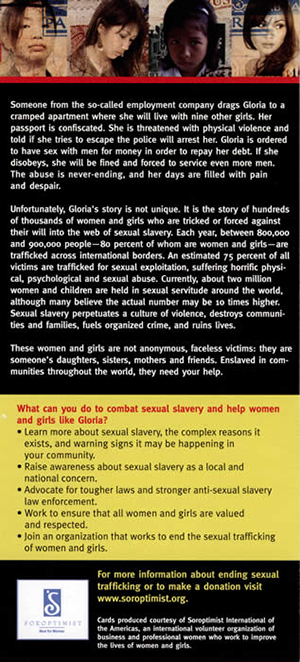 In 2003, a retired handyman admitted to holding five women as captive sex slaves underneath his home.
A woman kidnapped from New York City in 2004 was taken to the Capital Region against her will. She was taken to an acquaintance of the trafficker and she was tied up and she was raped repeatedly.
The phrase “human trafficking” probably makes you think of a some seedy criminal organization operating half a world away but it happens in the United States too.
January 11th is the National Human Trafficking Awareness Day, which marks the start of National Slavery and Human Trafficking Month.
The victims of human trafficking are primarily women. These women are someone’s mother, daughter, sister, friend…hidden behind locked doors and pulled shades…forced against their will to engage in sex acts with dozens of men a day.
Forcing people into labor or sex trades is an approximately $236 billion industry globally. According to the International Labour Organization, 27.6 million people—or 3.5 out of every 1,000—were victims of human trafficking in 2021, including 77 percent through forced labor and 23 percent through commercial sexual exploitation (source: US Department of Transportation).
Having common sense and that gut feeling of when to pick up the phone and call in something you see, you hear, or you become aware of is very important.